The problem
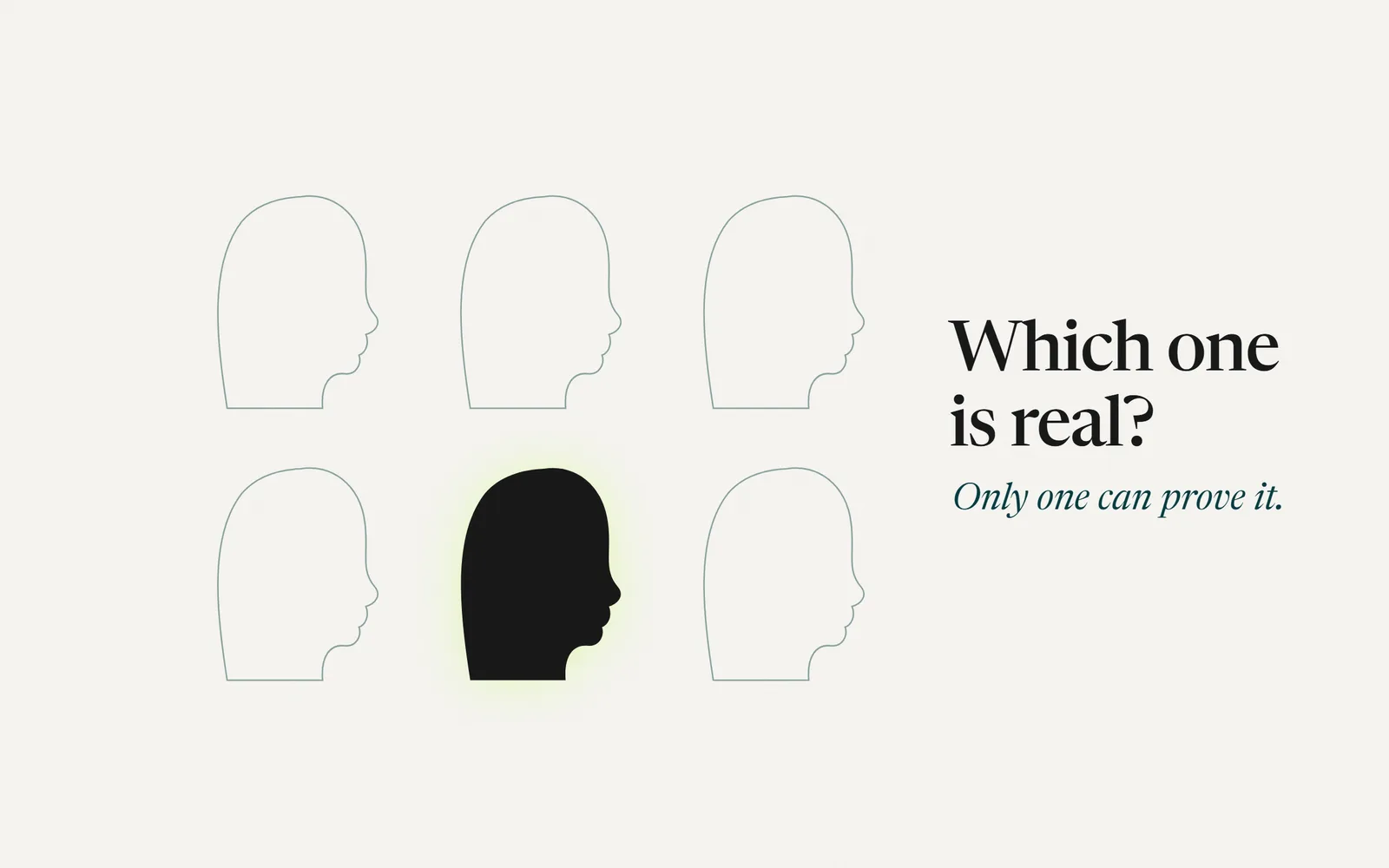
Faking a person got cheap. Nobody is exempt.
AI made it cheap to fake anyone. Every token project, school, employer and bank re-checks people inside its own walls, one check at a time, and the fakes still get paid. Six markets. Every number on this page carries its source.
The pattern
The same failure, in every market.
A face, a voice, a document and a wallet can all be generated now. Each institution answers that alone, inside its own walls, and asks the same people to prove themselves again and again. The checks pile up. The fakes keep getting through.
Faking got cheap
Synthetic identities, deepfake video and bot wallets cost a fraction of what they pay out.
Everyone checks alone
Every onboarding, product line and vendor refresh runs its own check. Real people repeat themselves.
Fakes still get paid
Airdrops, aid, paychecks and wires go out to people who are not who they say they are.
01 Crypto token launches and airdrops
Every launch is a budget meant for real people. Wallets can’t tell who they are.
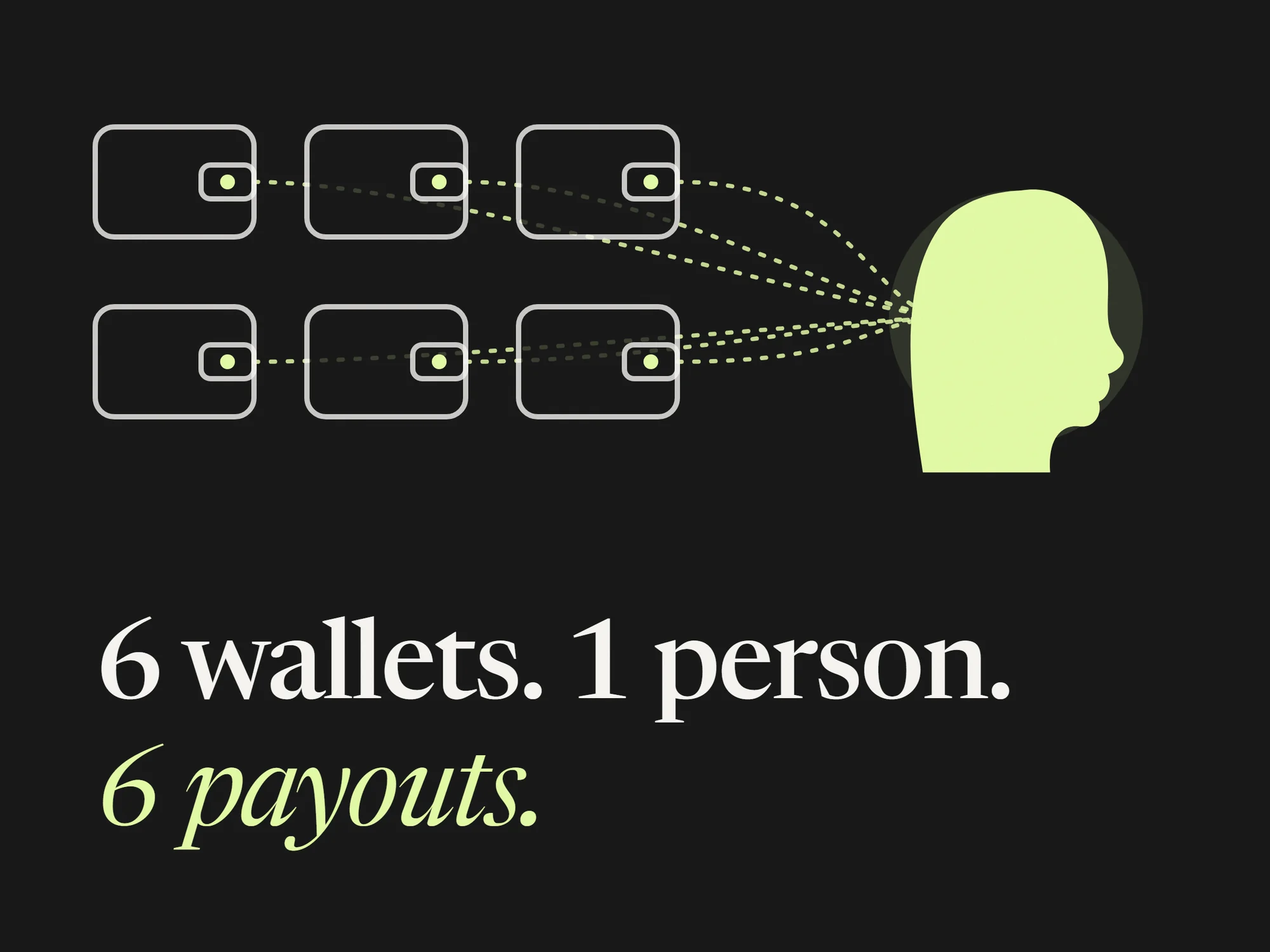
An airdrop, a points season or a token sale is a marketing budget paid in the project’s own token. Every wallet is a door, and nothing at the door can tell when the same person walks through it many times. Projects now clean their eligibility lists after the fact, with wallet analysis that guesses which addresses are linked. That’s a guess about wallets, not proof about people.
$351M
Estimated cost of Uniswap’s airdrop, about 88M UNI at roughly $4, with about 5.9 years to pay back against about 1.4 for a typical private startup. The payback covers every recipient, not only duplicates.
Tomasz Tunguz, November 2022 · tomtunguz.com
39.8%
Of Linea’s 1,297,203 eligible addresses removed as likely bots after wallet analysis with Nansen: 516,960 flagged.
The Block, January 2025 · theblock.co
60%+
Of aPriori’s airdrop reportedly claimed by about 14,000 connected wallets, each funded the same way.
Bubblemaps analysis, as reported November 2025
Under $200
Average reward per address for most Sybil groups in the Hop airdrop. Farming is cheap per wallet, so it pays to run it at scale.
Luo et al., IEEE ICBC 2025 · arXiv 2503.14316
Where Fuzzy fits
Pay people, not wallets. A claimant verifies once, in about 55 seconds in the app, with a government ID and a live selfie. The project gets a clear outcome and its team keeps every payout decision. Nothing is denied automatically. Built for launches open to U.S. participants.
How it works for token launches02 Higher education and federal student aid
Federal aid is going to students who don’t exist.
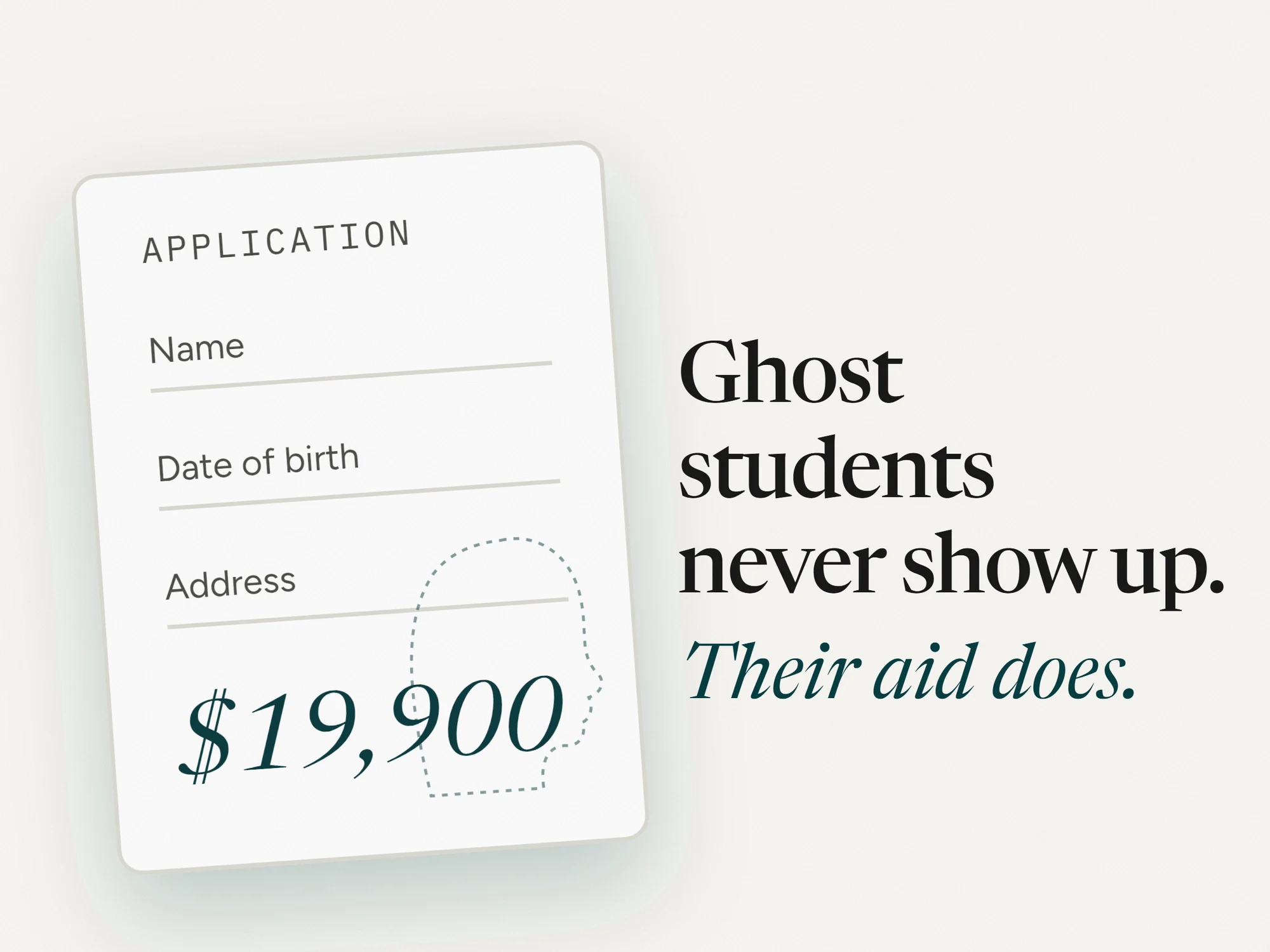
Fraud rings apply with stolen or synthetic identities, enroll, collect a disbursement and vanish before the first assignment is due. The Department of Education has run real-time fraud detection on FAFSA since April 2026. That changed the problem without solving it: ED flags the applicant, and the school has to resolve it. Resolving it means confirming a real person is there, which a transcript or a document check can’t do.
$350M+
In ghost-student federal aid fraud investigated over 5 years.
ABC News, January 2026
April 2026
ED’s real-time FAFSA fraud detection went live. H.R. 7892, the No Aid for Ghost Students Act, passed the House on June 10, 2026 and is pending in the Senate.
Federal Student Aid, APP-26-03 · H.R. 7892, 119th Congress
5,700+
Title IV institutions in the United States, every one of them disbursing federal aid.
IPEDS Fall 2025 data release memo, NCES · nces.ed.gov
Where Fuzzy fits Live
ED flags. The school resolves. Fuzzy is the resolution layer. An applicant proves once that they’re a real person and carries a campus passport the school can rely on. Barry University has run Fuzzy in production since July 2026. Nobody is blocked for not completing a check: the school keeps its own human review path and every decision.
How it works for schoolsBeyond crypto and campus
Hiring, banking, payments and wealth run on the same broken assumption.
That the person on the other end is who they say they are. Here is what that costs.
03 Enterprise hiring and remote workforce
The hiring funnel is now the attack surface.
State-sponsored actors, primarily from the DPRK, have industrialized employment fraud against US companies. Video interviews, background checks and document review are all defeated by generative AI and stolen identities. KnowBe4 was fooled after 4 rounds of interviews and verified references.
220%
Year over year growth in North Korean IT worker infiltrations, with over 320 companies hit in 12 months.
CrowdStrike 2025 Threat Hunting Report
Hundreds
Of Fortune 500 organizations have unknowingly hired DPRK IT workers, Mandiant said at RSAC 2025, with nearly every CISO admitting at least one.
CyberScoop 2025
$800M
Generated by the DPRK IT worker scheme in 2024 alone. The November 2025 DOJ action yielded 4 guilty pleas and $15M+ in civil forfeitures across 136+ victim companies.
US Treasury, DOJ
1,000 to 10,000
Fake employees are estimated to be embedded at companies globally, with a single operative often holding 6 to 7 simultaneous jobs.
Fortune 2025
Where Fuzzy fits
Building next. A verified human behind every candidate, before the first interview: a government ID, a live selfie and a liveness check, with your hiring team keeping every decision.
04 Consumer and retail banking
The bank’s hardest job is the first 30 seconds and the next 30 years.
Banks know who their customer was at onboarding. They’re less and less sure who is logging in today. Re-running KYC at every product line burns customer trust, and generative AI made synthetic identities cheap at scale.
$3.3B
US lender exposure to suspected synthetic identities at year-end 2024, an all-time high.
TransUnion H1 2025 State of Omnichannel Fraud Report
23%
Of surveyed institutions were hit by account takeover, a 7 point year over year jump.
Federal Reserve 2026 Risk Officer Report, Q4 2025 survey of 400+ risk professionals
75%
Of surveyed financial institutions reported debit card fraud attempts in 2025, accounting for 40% of total payments fraud losses.
Federal Reserve 2026
8,600
FDIC-insured banks and federally insured credit unions in the US, the credit unions alone serving 144.7M members.
FDIC Q4 2025, NCUA Q4 2025
Where Fuzzy fits
Building next. A verified human at account opening, and again at the moments that move money, such as a wire, a password reset or a new beneficiary.
05 Global payments
Payment rails were built for a world where you knew your counterparty.
Synthetic vendors, rerouted invoices and impersonated executives get cheaper to make every quarter. Issuers, acquirers, processors and corporates keep re-running KYC at every onboarding. Counterparties pay in friction. Institutions pay in chargebacks, write-offs and brand damage.
$3.046B
In reported US business email compromise losses in 2025, the second highest cybercrime category behind investment fraud.
FBI Internet Crime Complaint Center, 2025 Annual Report
86%
Of those funds moved by wire or ACH, landing inside live treasury workflows. The average incident exceeded $122,000.
FBI IC3 2025
6.37M
Small employer businesses in the US, every one of them a target running wire and ACH.
US Small Business Administration Office of Advocacy 2025
Where Fuzzy fits
Building next. A verified person behind a payment instruction before it is honored, for U.S. counterparties.
06 Wealth management and institutional securities
Wealth runs on relationship trust, and generative AI is taking it apart.
Firms verify at onboarding, then trust voice, video and email across decades of relationship moments worth 7, 8 and 9 figures. The whole stack assumes the person on the other end is who they say they are. That assumption is now the soft target.
$2.95B
In FTC-reported losses from imposter and impersonation scams, the most-reported consumer fraud category in 2024.
FTC 2024, via Morgan Stanley
$25M
Lost in a single deepfake CFO video call, when employees were tricked into wiring funds to a fraudster impersonating their CFO.
HBKS Wealth Advisors 2026
147,000+
Elder financial fraud victims in 2024, the wealth segment’s core demographic, at an average loss of about $83,000 each.
FTC 2024, via Morgan Stanley
168%
Year over year spike in detected money laundering accounts at US financial institutions in 2025, with impersonation scams now one of the 2 most common scam types nationally.
BioCatch 2025
Where Fuzzy fits
Building next. A verified human at the start of every client relationship, and again at the moments that move money or change instructions.
A modern approach to safer connections
Prove it once. Carry it everywhere.
Instead of every institution checking alone, the person owns the proof. Organizations get a clear outcome and keep the decision.
A credential the person owns
A government ID, a live selfie and a liveness check, in about 55 seconds in the app. The result is a proof-of-humanity credential the person keeps, renewed with the same quick check every 12 months.
Shared on their terms
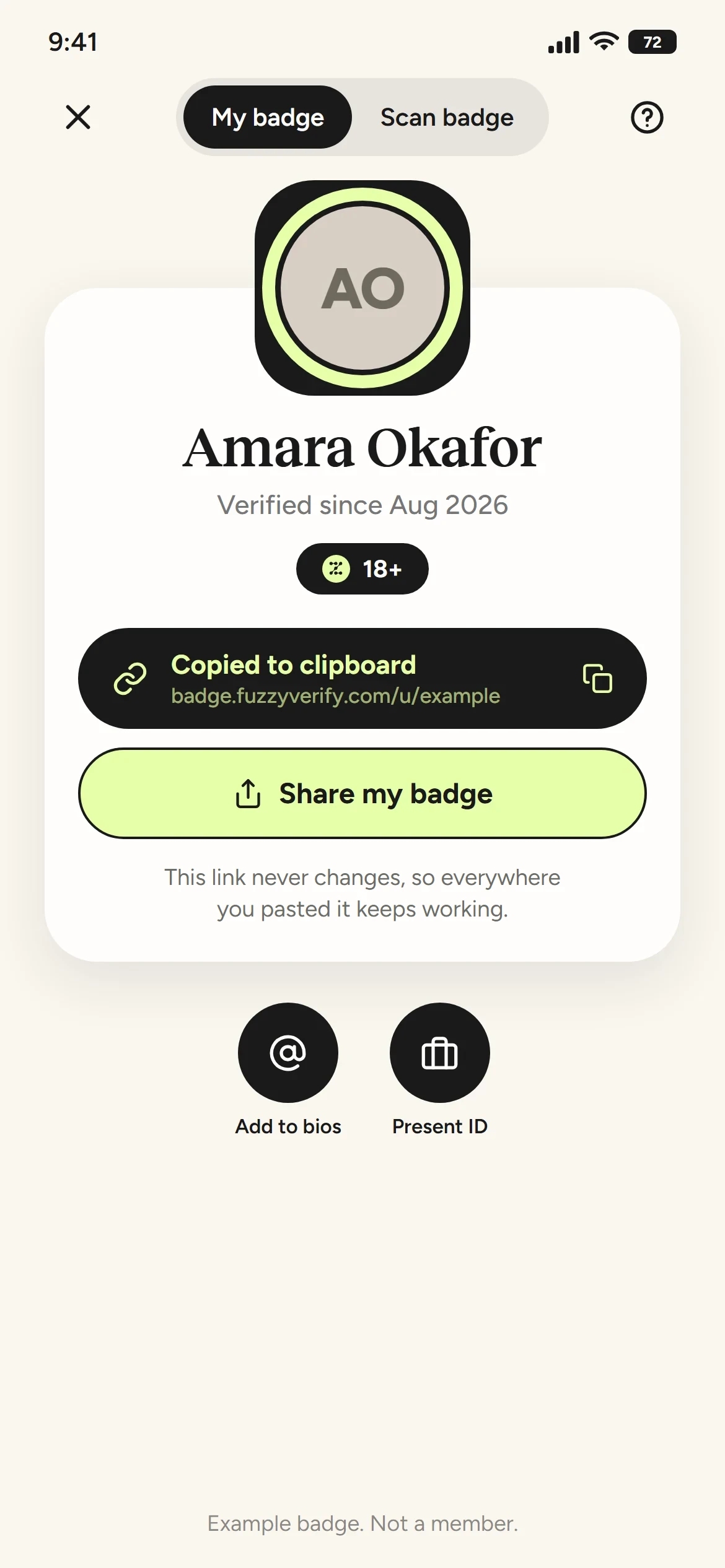
The badge link opens anywhere, no app needed. Members can turn it off and on whenever they like.
A clear outcome, your decision
Organizations see that a check cleared or did not. Fuzzy reports that a check did not clear, never why. Nobody is blocked for not completing a check, and the organization keeps its own review path and every decision.
Next step
Put a verified human where it matters most.
See how a check works, or talk to us about a pilot for your launch or your school.