Fuzzy Verify for higher education
Give every student a credential they keep.
It is free to them, it belongs to them, and it works everywhere on campus that needs a verified human. It is also how your office resolves a federal aid flag in seconds instead of hours.
Why schools buy it
Two strong applicants to a school like yours.
One is real. One does not exist. Today, the school has no way to tell them apart.
APPLICANT 1
Jordan Avery
#CSC-26-08114
- High school diploma
- Official transcript
- Letters of recommendation
- Career goals essay
Admitted · Fall 2026 · federal aid disbursed
APPLICANT 2 · THE SCHOOL CANNOT SEE THIS LABEL
George Maddox
#CSC-26-08115
- High school diploma
- Official transcript
- Letters of recommendation
- Career goals essay
Admitted · Fall 2026 · federal aid disbursed
Jordan graduates with honors.
Four years. A degree. A real life that started here.
George was never here.
The aid was real. The student was not. Every paper in that file was real too, which is exactly the problem.
The scale of it
This is not a rare event any more.
$1B+
Projected savings from the Department of Education's own aid-fraud prevention effort, in a single cycle.
Projection: U.S. Department of Education press release, April 27, 2026. Realized in the first ten weeks of screening: $212M stopped and 53,000 applications rejected, per Under Secretary Nicholas Kent at the Department’s Higher Education Fraud Summit, July 2026. ED built the screening. Resolving what it flags is the institution’s job.
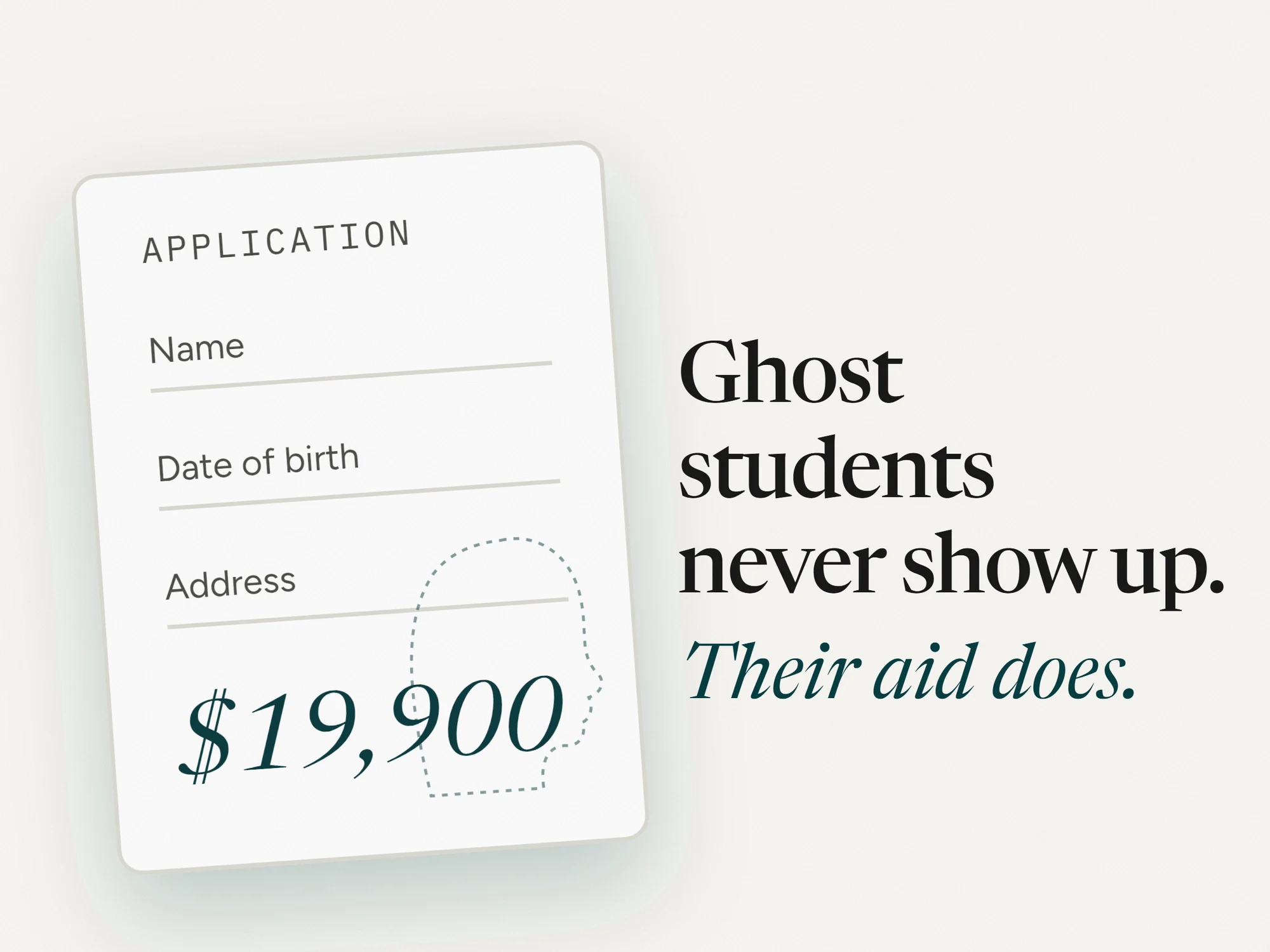
$19,900
Federal aid eligibility at risk per ghost student, per year.
Maximum Pell plus maximum independent federal loans. U.S. Department of Education, 2025-26.
$350M
In ghost-student aid fraud investigated over five years.
ABC News, reported January 2026.
5,700+
Title IV institutions in the United States, every one of them exposed to the same gap.
NCES IPEDS, 2024-25 reporting year: 5,760 Title IV institutions. We quote a floor, not the exact count, because the series falls about 80 a year.
What is actually required of you
The Department of Education flags. You resolve.
We want to be precise about this, because plenty of vendors are not. One of these is a live obligation today. The other is a bill that has not finished moving.
Real-time FAFSA fraud detection.
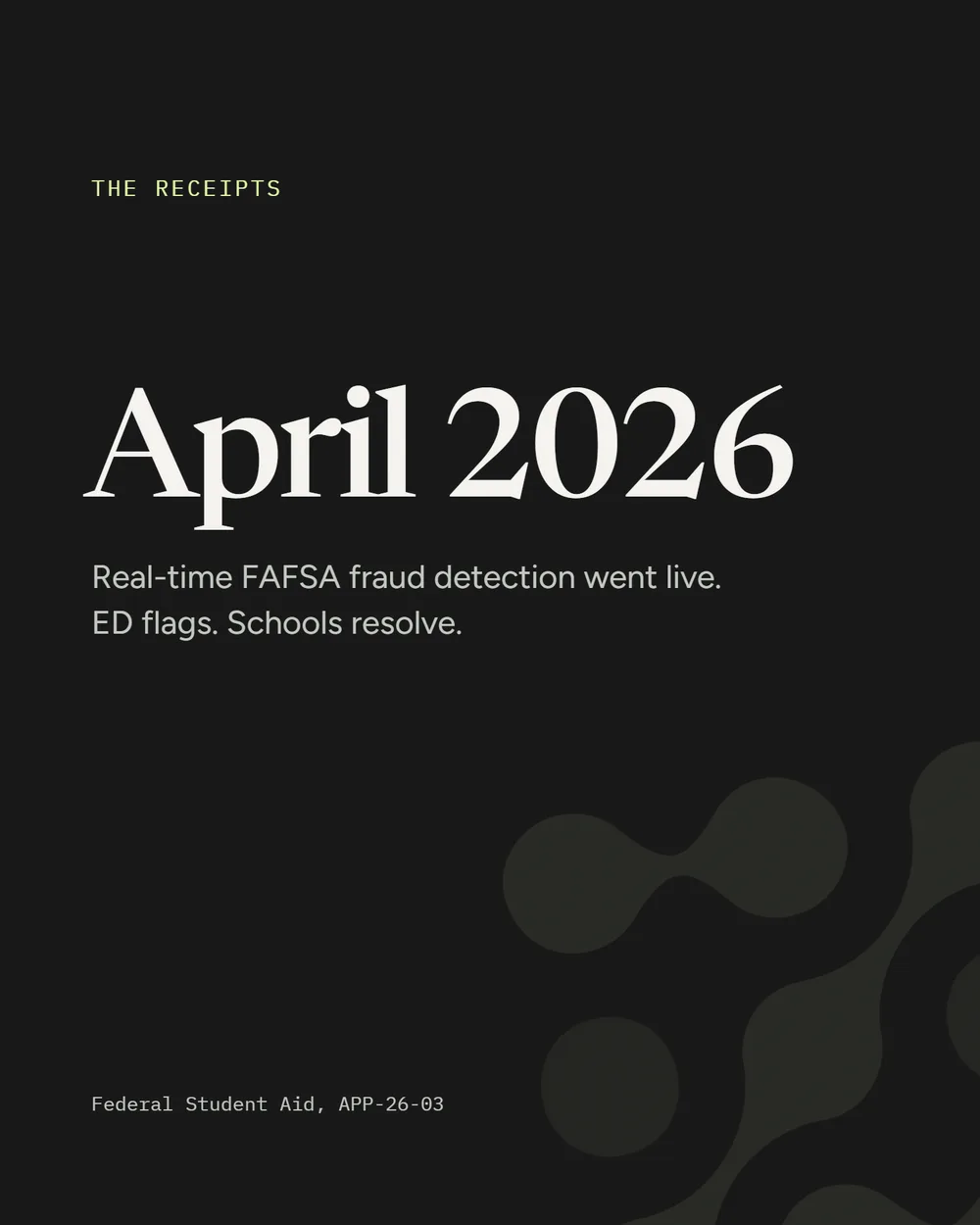
Federal Student Aid already flags suspicious applicants inside the FAFSA, and has since April 2026. Resolving those flags is the institution's responsibility, right now, with no new legislation required. That is the work Fuzzy does.
H.R. 7892, the No Aid for Ghost Students Act.
Passed the House 249 to 172 on June 10, 2026, and would require live, synchronous audiovisual verification of flagged applicants. The Senate companion is still pending in the HELP committee, so this is not yet law and we will not tell you otherwise. Implementation guidance has not been written.
In production
And you watch it work, live.
Status for every applicant, the funnel, and an exportable audit record for each check. Barry University runs every application through Fuzzy, undergraduate and graduate, and ran their full fall enrollment cycle through it: roughly 1,042 new accounts and 709 verifications. The console below is a demo tenant with representative data, not Barry’s.
CHECKS STARTED
512
flagged applicants
VERIFIED
466
91% of started
MEDIAN RESOLUTION
1m 48s
start to verified
STAFF TOUCHES
0
on a clean verification
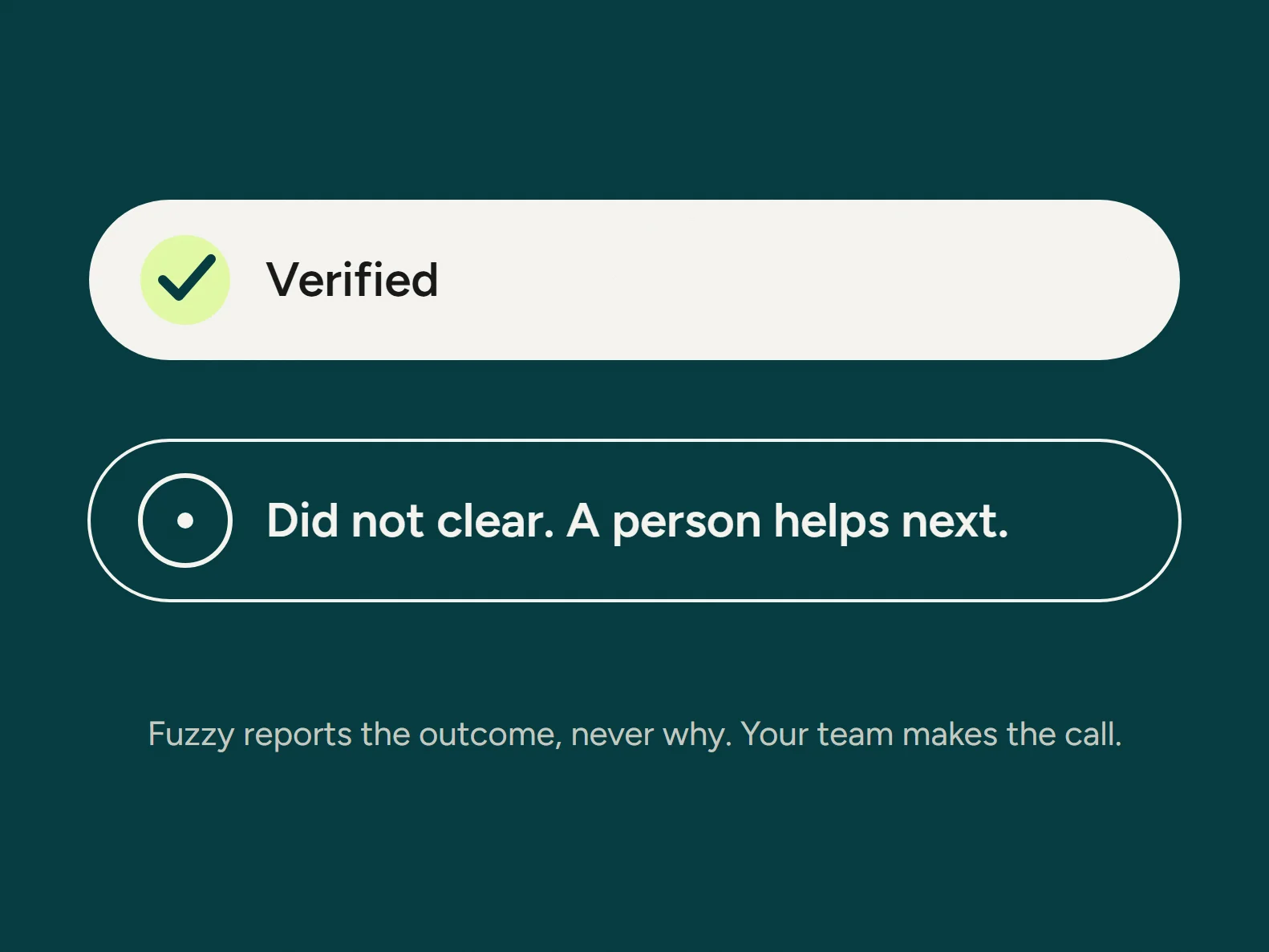
OUTCOMES · CATEGORICAL, NEVER WHY
RECENT CHECKS · TOKENIZED
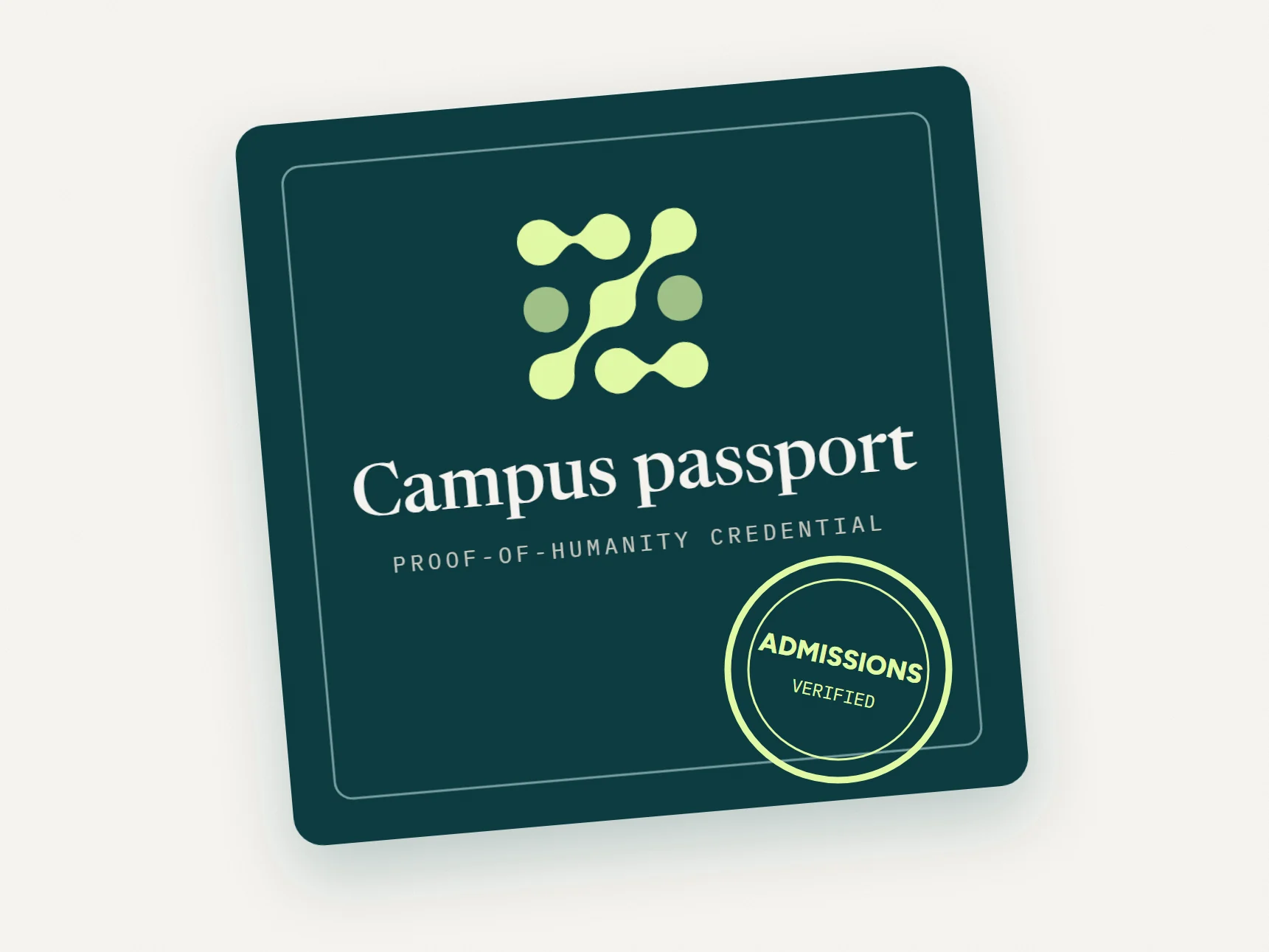
The campus passport
The application ends. Your students keep the credential.
The credential belongs to the student, not to your database. It is free to them, it renews with one live check every twelve months, and it works everywhere else on campus you need a verified human. Your students verify once a year, not once per office.
CLEARED
Online final exam.
Proof that a live human is behind the login, without proctoring software watching a bedroom.
CLEARED
Aid refund account change.
The single moment fraud rings target hardest, and the one most worth a second check.
CLEARED
Dorm move-in.
Keys handed to a verified person, on a day when nobody has time to verify anyone.
Student to student
The moments a university cannot chaperone.
Most of the risk in a student's year is not in the admissions file. It is in the dozens of ordinary times they meet someone they found online. The passport is already in their pocket, so they can prove who they are and ask for the same before they show up.
Subletting a room for the summer
A stranger with a listing, a deposit, and no accountability.
Finding a roommate
Nine months of living with someone found in a group chat.
Selling a textbook or a ticket
Meeting in a parking lot to hand over cash.
Splitting a ride home for break
Six hours in a car with someone from a campus board.
Meeting a tutor or a study partner
Often off campus, often at night, often alone.
A first date
The one every student actually uses, and the reason this company exists.
What you have to build for this: nothing
And what we will not claim. A badge tells a student that someone is a real, unique person. It does not tell them that person is safe, and we will never market it as though it does. What it removes is the easiest lie, told at the moment it does the most damage.
Nobody gets blocked for failing to verify.
This is a product rule, not a courtesy, and it is the answer to the equity objection before anyone raises it. Anyone who cannot complete a check gets an in-person or video path through your own admissions office. A student without a smartphone, without a current government ID, or without a stable address does not lose access to financial aid because of us. We will put that in the contract.
After the diploma
The credential does not expire when the enrolment does.
Your students keep it, because it was always theirs. It goes with them to a first apartment, a marketplace listing, a gig-work sign-up, a meetup in a city where they know nobody. Same badge, same link, no re-enrolment.
A first apartment
Proving you are real to a landlord who has never met you.
Marketplaces
Buying and selling with strangers, at higher and higher values.
Dating and meetups
The place synthetic identity does the most personal damage.
Gig and contract work
Both sides of a job neither party can verify today.
Every person carrying one makes the next introduction easier, because the ask stops being unusual.
That is not a growth tactic bolted onto the product. It is simply what happens when a credential belongs to a person instead of to a database. Which means the thing you bought to resolve federal aid flags is also the thing your alumni are still using in five years. It is unusual for a compliance purchase to double as a graduation gift, and it is the part of this we are proudest of.
For your security review
The answers your questionnaire will ask for.
Your school never holds an ID or a biometric.
Capture happens inside the identity engine's hosted flow, and Fuzzy never sees the document. What comes back to you is a category, never an image and never a reason.
One API call. No new systems, no hardware.
The subject is identified by a one-way lookup hash. On the partner-initiated path, where an institution sends us an applicant to verify, we also hold that applicant’s name and email until the request is resolved. Live in weeks, not quarters.
Categorical outcomes and a tamper-evident audit record.
Records are append-only and chained with a keyed hash, so history cannot be rewritten, including by us.
Certifications, attributed honestly.
SOC 2 Type II, ISO 27001, ISO 30107-3 and FedRAMP Ready are certifications held by Incode Technologies, our identity engine, not by Fuzzy. The 99.6% fraudulent-document detection rate is Incode's figure.
FERPA, handled through a data processing agreement.
Send us your DPA template and your counsel's redlines rather than the reverse.
Accessibility.
VPAT and Section 508 conformance work is in progress on a parallel track, which is the arrangement Barry accepted. We will tell you exactly where it stands rather than claim it is finished.
Start a pilot
Tell us two numbers and we will send back a real scope.
schools@fuzzyverify.com
Send us your enrolment and whether you want every applicant verified or only the ones the Department of Education flags. You will get a pilot scope and honest numbers back in one email from a person, not a sequence. If we are not a fit for your situation we will say so.
Live in weeks. One API call, no new systems, no hardware. Students verify in about 2 to 3 minutes, free to them, and they keep the credential afterwards.